
Clinical Applications
Practical Use in Therapy Settings
- Early-therapy life mapping
- Contextualizing presenting concerns
- Identifying life patterns and transitions
- Supporting trauma-informed pacing
A gentle, visual invitation to slow down and reflect on the moments that shaped you, both the ones you remember clearly and the ones you may have overlooked, so you can recognize patterns, make sense of your journey, and see your life as a connected story rather than a series of isolated events, one memory at a time.
As memories begin to take shape in front of you, something often shifts. Experiences that once felt random or disconnected start to reveal meaning and continuity. By giving each moment a place, you create space not just for understanding, but for compassion toward your past self, and clarity about the path that has brought you here.

The Jeremiah Puzzle is a structured narrative-mapping tool designed to complement psychological practice. It helps clients externalize life experiences visually, reducing cognitive and emotional overload.
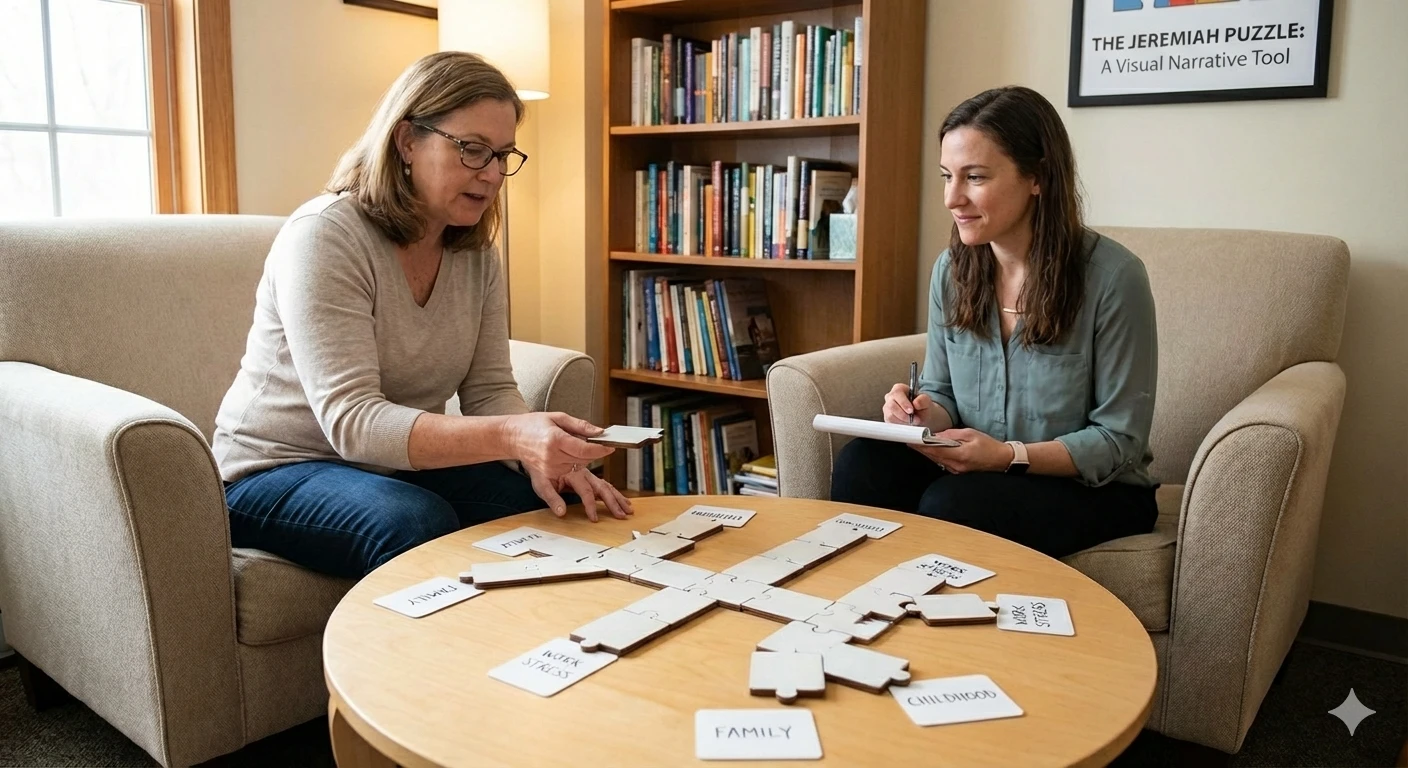


The puzzle is non-diagnostic, non-directive, and adaptable across narrative, humanistic, and trauma-informed approaches.
See your life from a new perspective. Connect the moments that shaped you and discover where grace has been guiding your path
The Jeremiah Puzzle is a hands-on life-mapping tool that helps you organize your memories, identify turning points, and recognize the God-incidences that shaped your story.
Yes! We offer beginner-friendly classes for all ages. Whether you're learning the rules or your first opening, our coaches guide Anyone who wants a clearer view of their life, individuals, couples, families, seniors, counsellors, and ministry leaders. The puzzle adapts easily to personal reflection or group conversations.you every step of the way.
Because the story isn’t prewritten. You choose the memories that matter, write them on the pieces, and arrange them in a way that shows how your journey unfolded.
Green dots mark life incidences, moments that felt too timely, too precise, or too meaningful to be mere coincidence. Over time, these dots reveal a pattern of divine involvement.
Not at all. Anyone can benefit from organizing their memories and seeing their story visually. Many users, however, naturally begin to notice spiritual patterns they hadn’t seen before.
There’s no fixed timeline. Some people work on it over a weekend; others build it gradually over months. The process is meant to be reflective, not rushed.
Yes. Many professionals find it extremely helpful because it gives them a visual, chronological understanding of your past, making conversations more focused and insightful.
Absolutely. Families often use it to share stories across generations, and couples gain valuable insight by building separate puzzles and comparing their journeys.
That doesn’t matter at all. Short notes, keywords, or even a single phrase are enough. The goal isn’t polished writing, it’s capturing meaningful moments.
Simply add another piece. Your puzzle is meant to grow with you. New memories or insights often appear once you start arranging the story.