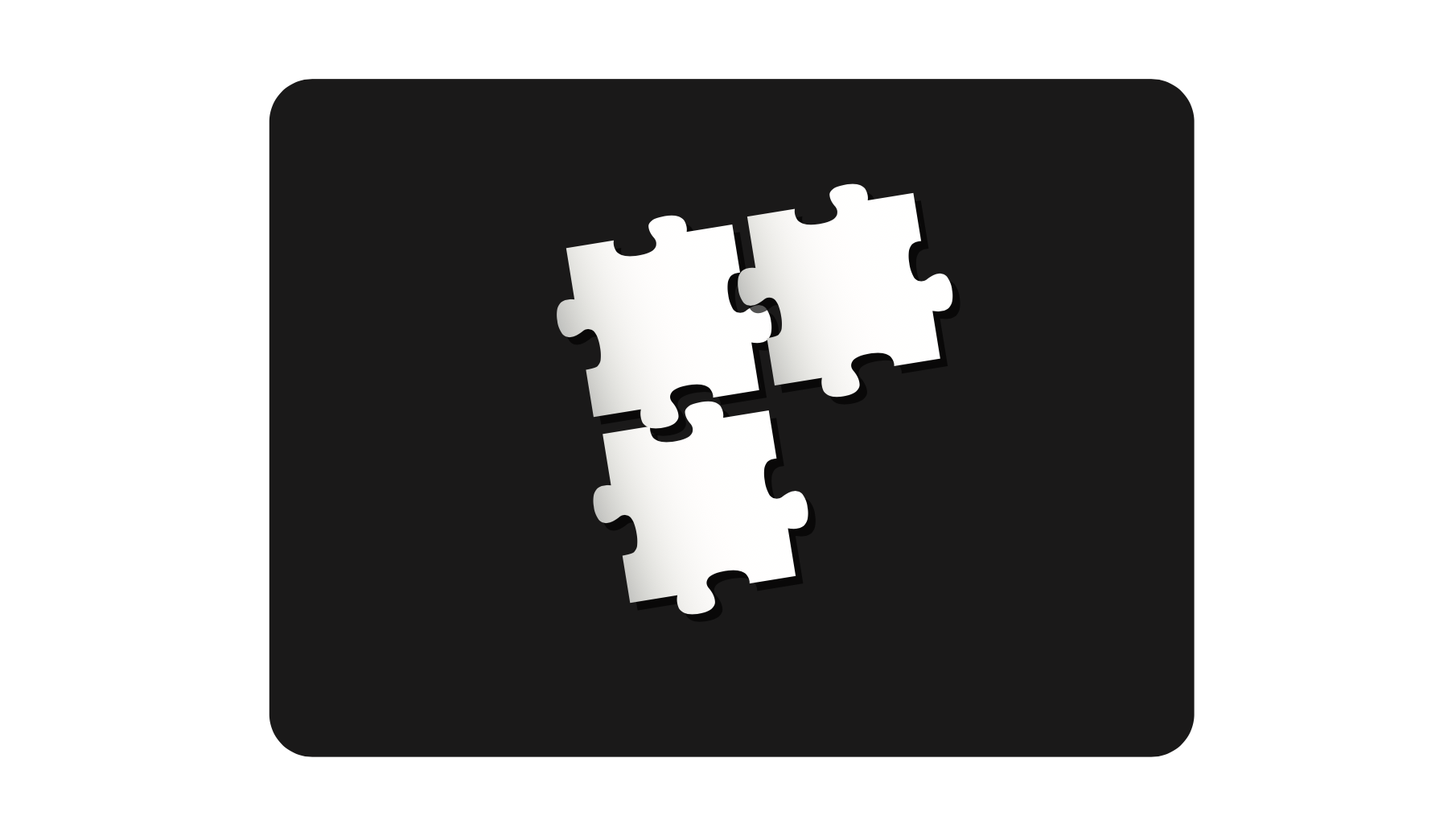
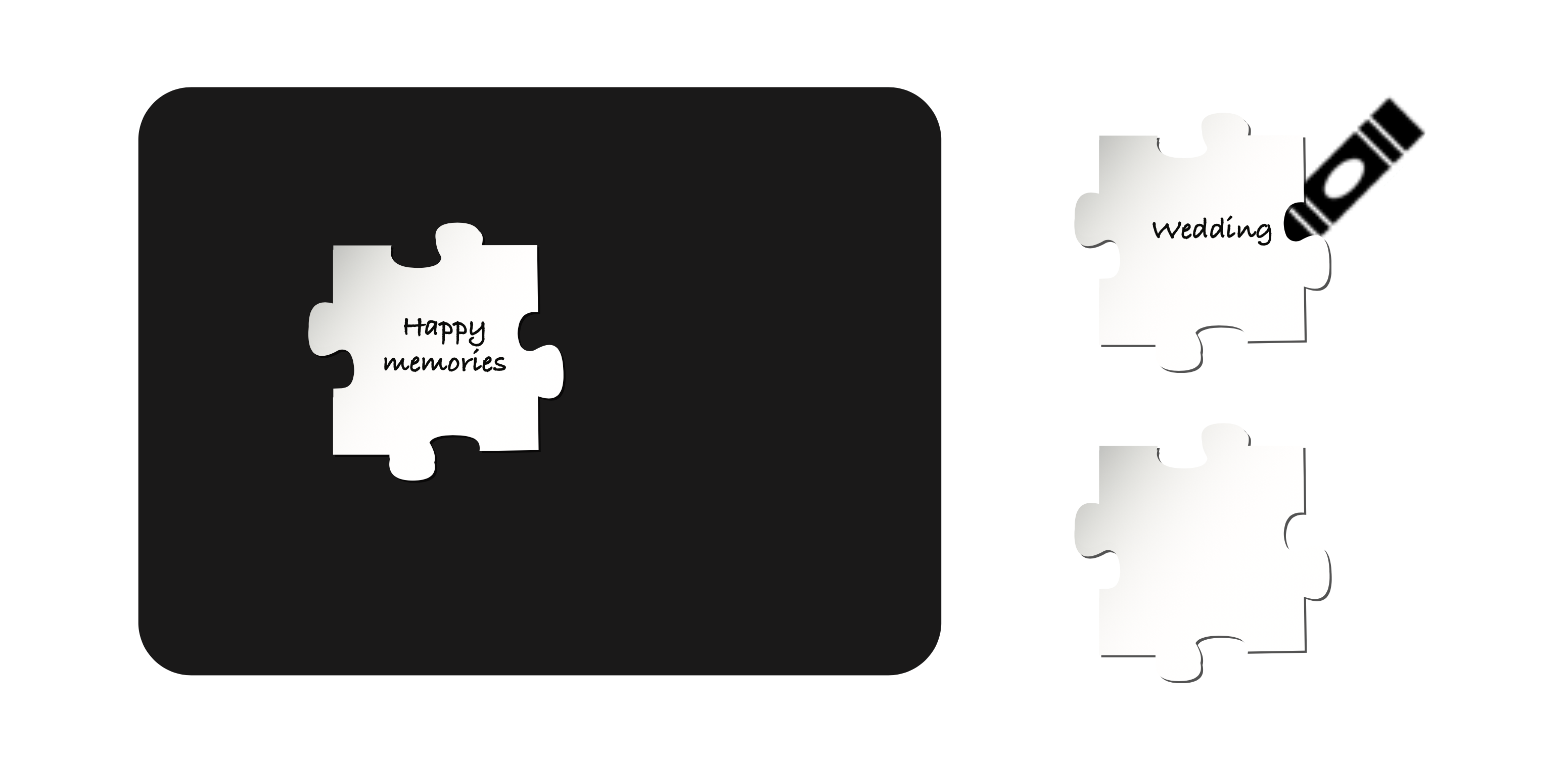
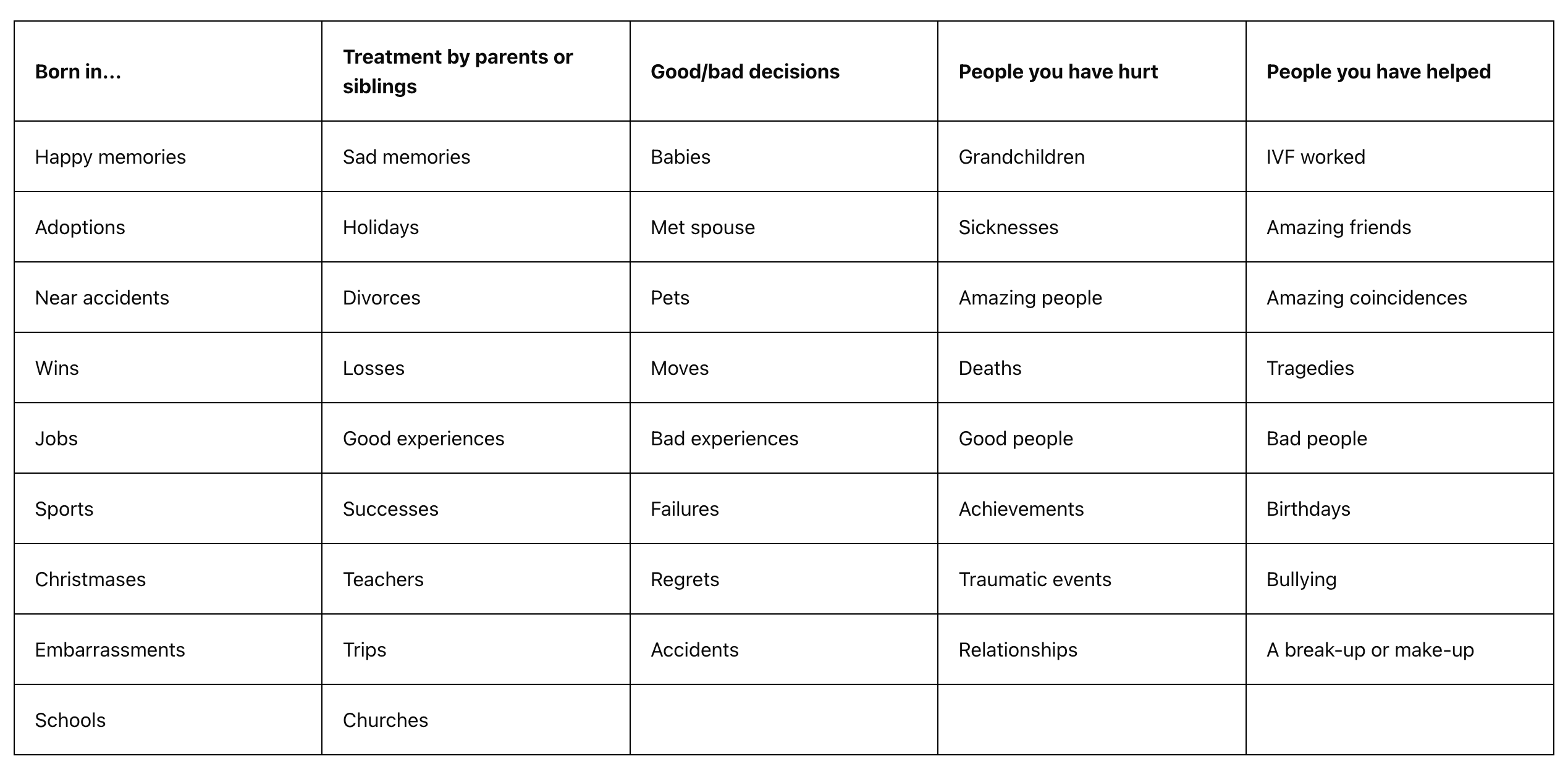
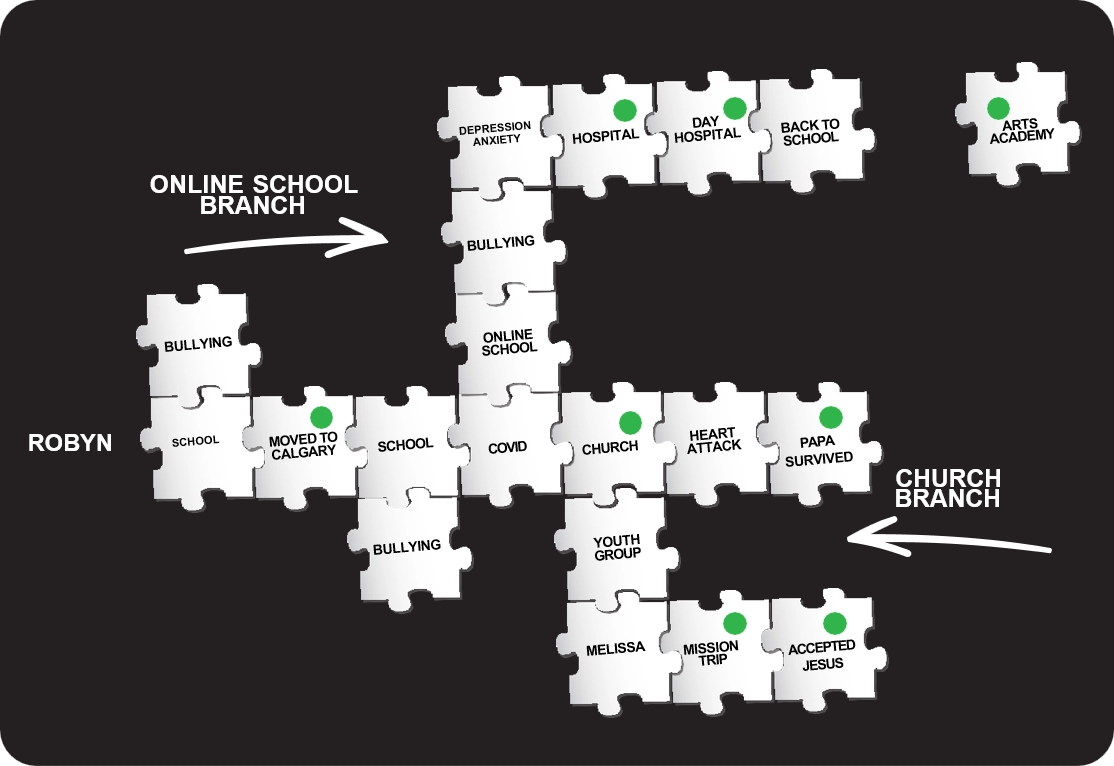
When you have finished writing your memories on the pieces, start putting pieces together that are related in some way – either chronologically or logically. One suggestion is that you start in the middle of the left side of the blackboard and continue to the right in chronological order. Create a central line of pieces that shows the general direction of your life and add ‘branches’ on either side that show specific areas of your life such as school, church, job, family, sports etc. And then see where that takes you.
Have a look at the sample puzzle shown below in these instructions for some ideas. The sample puzzle also shows you that the white markers can be used to write additional information directly on the blackboard. Feel free to design your puzzle anyway that you want. Another style is to just have a single line of events in a serpentine style that reflects the ups and downs of your life.
Also, if you run out of space on the board, try using two lines and continue your puzzle on the second line of the puzzle. You could also consider adding more branches to describe categories of events like jobs, family, church etc. It’s your life so you decide what suits you best.
Identify key events and coincidences in your puzzle with a green dot
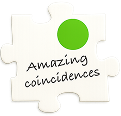
Now, take the green marker and put a green dot on each piece that really stands out because it is an amazing coincidence or where the direction of your life changed.
A coincidence is defined as something that’s not planned or arranged but seems like it is. Those pieces could include where you were born, the family you ended up being part of, people you met, a job that you got, a near accident, a health issue, how you met your spouse, and so on.
Now that you have your puzzle…
What can you use it for?
Use your puzzle and especially the green dots to understand your life so far and how you ended up where you are.
Look for:
• Interesting coincidences
• Life-changing events
• People you met who became important in your life
• Good or bad relationships
• Good or bad decisions
• People who have hurt you or you have hurt
• Times or events that you enjoyed
• Any series of events that had an effect on where you are today
• Any patterns that you can see in the course of your life
• Any loops where you keep coming back to the same piece
• Any dead ends where you got stuck or are still stuck (jobs, finances, education, relationships…)
• Highlights and lowlights in your life and the pieces that led up to them
• Any paths that seemed negative or overwhelming but turned out good in the end
• Anything that might help you as you move forward
Your puzzle is also a very useful tool because it…
• Is an ongoing work that continues to grow as new events occur
• Can be a way to capture personal or family memories
• Can be a way to record your grandparents’ fading memories
• Can be the basis for writing your memoirs
• Can be used to show your friends what you have done so far in your life
• Can be used to help your counsellor or therapist better understand your past
• Can be used for couples or marriage counselling
• Can be used for addiction counselling to identify harmful patterns
• Can be mounted on the wall where the green dots can act as a reminder of how you ended up where you are today
• Can help you use previous experiences and patterns to make better decisions in the future
• Can – above all – show you all the coincidences* in your life
Let’s talk about those coincidences (green dots)
What about the coincidences that have shaped you or changed the direction of your life?
How many such coincidences have you already experienced in your life?
Do you have an explanation for those coincidences?
Do you think you were just lucky or unlucky at those times?
Do you think that you might experience more coincidences in the future?
We believe that those coincidences are actually God trying to get your attention or God guiding you in a particular direction because He has a purpose and a plan for you. Or do you have a better explanation?
If you want to know more about those coincidences, and why God could be behind them, just go to:
"In any case, be sure to hang your puzzle on the wall at a prominent location so the green dots can regularly remind you of how you ended up where you are, and simply enjoy the puzzle of your life."