
May 9, 2025
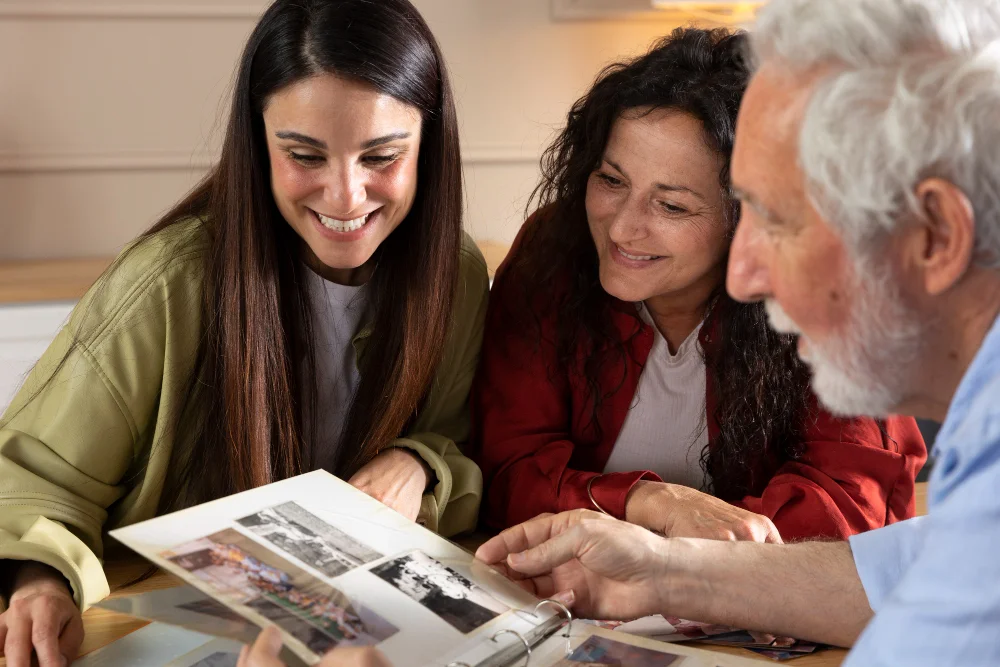
Every family has stories that never make it into a photo album. They live in fragments: a sentence your dad repeats, a look on your mom’s face when a certain year comes up, a grandparent’s laugh that somehow carries both joy and grief. The tragedy is not that families have hard seasons. The tragedy is that the meaning of those seasons often dies with the people who lived them.
A family memory project is your chance to change that. The simplest approach is not a recording studio, a complicated genealogy platform,or a memoir you never finish. It is a shared, visual process that gets stories out of heads and into a structure everyone can see. A life story puzzle does that because it makes memory tangible and movable: one piece at a time, in plain language, without pressure to be perfect.
You are building a shared narrative, not a courtroom transcript. You are not trying to get every date correct. You are trying tocapture what happened and why it mattered.
That distinction matters because families rarely disagree about facts as much as they disagree about meaning. One sibling remembers “a strict house.” Another remembers “a safe house.” A family puzzle can hold both. You can place both realities on the board without forcing agreement.
The hardest part is often the first ten minutes. People donot know what to write, or they feel exposed. Use prompts that invite story rather than confession.
Try these:
· “What is a place you miss?”
· “What is a season you are proud you made it through?”
· “Who helped you most when you were young?”
· “What was your first job and what did it teach you?”
· “What is one decision you would make again?”
· “What is one moment you knew you were loved?”
If faith is part of your family language, add:
· “Where do you see God’s help looking back?”
· “What prayer do you believe was answered?”
These questions produce concrete pieces. Concrete pieces create momentum.
Start with anchor years that everyone can understand. Use decades or “eras” rather than exact months.
A simple anchor structure:
· Grandparents: early life, marriage, first home, career era, major move, health transitions.
· Parents: childhood era, marriage era, children era, career pivots, hard seasons.
· Adult kids: school seasons, early jobs, relationships, turning points.
Once anchor pieces are down, you can add detail around them. Without anchors, the board becomes a random collection of memories with no map.
Family storytelling can heal, but it can also re-open wounds. Set rules in advance, and treat them as non-negotiable.
Recommended rules:
1) “I remember” language only. No accusations.
2) No one corrects another person’s memory. You can add, not erase.
3) You can pass on any question. Silence is allowed.
4) You decide what stays private before you start sharing photos online.
5) If emotions spike, you take a break. The goal is connection, not closure in one night.
If your family has unresolved trauma, consider doing this in shorter sessions or with a counselor present. A tool is powerful; it should beused wisely.
The most valuable memories are often not the “big events.”They are the small turning points:
· The teacher who noticed you.
· The coach who believed in you.
· The neighbor who fed you when money was tight.
· The phone call that changed your direction.
· The family rule that shaped your identity (good or bad).
Add pieces for:
· Mentors and helpers.
· Traditions (Sunday dinners, road trips, church camps).
· Repeated phrases you heard growing up.
· Moments you learned courage, shame, joy, or faith.
Those pieces explain the person, not just the timeline.
A puzzle board is the working space. Your archive is what you preserve.
At the end of each session, capture:
· Photos of the puzzle sections (wide shots + close-ups).
· A simple “index” list: year/era, key events, key people.
· Optional audio: each person explains 3 to 5 pieces they wrote.
You can store these in a shared folder, label them by decade, and build a digital legacy without needing a complex system. The key is consistency, not perfection.
Here is a simple facilitation plan you can use at a holiday gathering or family weekend:
0 to 10 minutes: Set rules and define the goal (“We want a map, not a debate.”)
10 to 25 minutes: Everyone writes 5 anchor pieces quietly.
25 to 45 minutes: Place pieces on a shared timeline (one person at a time).
45 to 60 minutes: Build two clusters: “moves and homes” and “work and calling.”
60 to 75 minutes: Add meaning pieces (“What did that season teach you?”)
75 to 85 minutes: Mark helpers and “green dot” moments if your family does that.
85 to 90 minutes: Take photos and agree on the next session.
You will be amazed how much structure appears in 90 minutes when everyone participates.
If your family recognizes God-incidences, keep it simple:
· Anyone can mark a dot on their own pieces.
· No one is required to mark dots.
· If someone disagrees, you do not argue; you respect conscience.
Healthy language sounds like:
· “This felt like provision.”
· “I cannot explain how that door opened.”
· “It might be coincidence, but it changed us.”
This approach keeps faith reflection inviting rather than performative.
A good family memory project produces outcomes you can feel:
· Younger generations finally understand why older generations are the way they are.
· Shame loses power when it is named and placed in context.
· Gratitude increases because people can see the sacrifices that built their foundation.
· Forgiveness becomes possible because the story becomes more complex than “villain vs victim.”
Sometimes the biggest gift is simply this: “I did not know.” The puzzle becomes a bridge.
You do not need the whole family to start. Start with one willing person. Build one decade. Capture it. Repeat.
If you want a simple first move: invite a parent or grandparent to a one-hour session and ask them to write five pieces about “moves, work, and who helped.” Put those pieces on a timeline. Take a photo. You just saved a story that would have disappeared.
And if the process opens deeper wounds, treat that as information, not failure. A visible story shows where healing is needed, and it gives you a respectful way to pursue it together.

Because every life holds meaning, every memory matters, and every green dot points to God —who’s been there all along.