May 9, 2025

You do not need to be a writer, an artist, or a therapist to map your life in a way that makes sense. You need a repeatable method and permission to start imperfectly. A puzzle of your life is exactly that: a visual way to place your memories where you can see them, move them, and connect them until your story becomes coherent.
Most people carry their past like a box of unsorted photos: meaningful, but scattered. The goal is not to prove anything, impress anyone,or perform your life for an audience. The goal is clarity. When your story is visible, it is easier to see themes, turning points, and the relationships between events. And for many people, it is easier to see the moments that feel like God was quietly at work, even if you did not notice at the time.
A life map turns “I remember a bunch of things” into “I understand what shaped me.” When events stay in your head, they tend to reorganize themselves around your current mood: regret highlights regret, fear highlights fear, and gratitude highlights gratitude. A visual timeline is less emotional and more honest. It does not remove feeling; it gives feelings a stable reference point.
A practical benefit: life mapping reduces overwhelm. You are not trying to “write your autobiography.” You are adding one piece at a time,and you can stop at any time without losing progress.
Start with anchors. Anchors are events you can place confidently, even if the details are fuzzy. Aim for 10 to 20 anchors before you worry about anything else.
Examples of anchors:
· Birth places and moves (city-to-city or house-to-house).
· Schools, programs, graduations.
· First job, major job changes, layoffs, career pivots.
· Relationships: meeting a spouse, marriage, separation, reconciliation.
· Children: births, adoptions, miscarriages, major milestones.
· Health: diagnoses, surgeries, recoveries, relapses.
· Losses: deaths, funerals, endings that changed you.
· Spiritual moments: conversions, doubts, breakthroughs, church changes.
If you are stuck, use this prompt: “What season of life do I talk about most often?” Whatever comes out of your mouth is usually sitting close to the surface for a reason.
Use a layout that keeps time visible. You can choose one of three common patterns:
1) Left-to-right timeline (most intuitive): childhood on the left, today on the right.
2) Top-to-bottom timeline (best for smaller spaces): early years at the top, present at the bottom.
3) “River with tributaries” (best for complex lives): a main timeline with side branches (education, work, relationships).
Pick one and commit. The key is consistency. You are building a map, not a collage.
Once anchors are down, you will be tempted to keep adding events forever. Do add events, but start adding meaning in parallel. A helpful narrative therapy prompt is: “What did I decide about myself here?”
For each major piece, add a second line (or a nearby piece) answering one of these:
· What did I believe was true after this happened?
· What did I learn to fear?
· What did I learn to value?
· What did I learn to hide?
· Who helped me? Who hurt me? Who disappeared?
This is how a timeline becomes a story. It also shows you where false conclusions formed, and where healing is needed.
Even with a timeline, life is not one straight line. Your story has clusters. Clustering makes your puzzle readable and reveals patterns.
Common clusters:
· Family of origin (childhood dynamics, siblings, parents).
· Identity and self-worth (bullying, achievement, rejection, belonging).
· Calling and career (skills, mentors, “open doors,” closed doors).
· Relationships (trust, attachment, boundaries, reconciliation).
· Faith (seeking, doubt, church seasons, prayer answers).
· Health and resilience (crises, recovery, coping skills).
Create small “islands” of pieces around each cluster and connect them back to the main timeline with one or two links. The goal is not maximal detail; it is usable clarity.
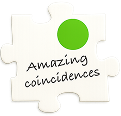
Some coincidences are just coincidences. Some coincidences feel like provision, protection, or guidance. If your practice is to mark God-incidences (often with a green dot), do it with both faith and humility.
A God-incidence is typically marked by at least one ofthese:
· Timing you could not have engineered.
· An outcome that aligned with a prayer, a need,or a warning.
· A person showing up “out of nowhere” with exactly what you required.
· A closed door that later looks like mercy.
· A repeated theme you notice only in hindsight.
Do not debate every dot. Mark what you honestly believe, and leave room for uncertainty. The point is reflection, not superstition.
Here is a mini example of how to build a readable section:
Anchor pieces:
· 2009: Move to a new city (felt alone).
· 2011: First real mentor at work (confidence grows).
· 2013: Major relationship ends (identity shakes).
· 2014: New church community (belonging returns).
· 2016: Job loss (panic).
· 2017: Unexpected job offer from a former contact (relief, green dot).
Meaning pieces (placed near anchors):
· After 2009: “I am on my own.”
· After 2011: “I can learn; I am not stuck.”
· After 2013: “If I am rejected, I am unlovable.”
· After 2014: “I am seen; I can be known.”
· After 2016: “I am not safe; everything can collapse.”
· After 2017: “Provision can come from places I forgot existed.”
Connections:
· Link 2011 mentor to 2017 job offer (same network).
· Link 2013 breakup to 2014 community (healing pathway).
· Link 2016 job loss to 2017 offer (closed door to open door).
Notice how quickly a story appears. You can do this with any decade of your life.
If you are doing a puzzle of your life with family, set ground rules:
· Each person gets to write their own pieces.
· No one is allowed to correct another person’s memory.
· Use “I remember” language, not “you always”language.
· Decide what stays private before you start.
Helpful prompts:
· “What was your happiest season?”
· “What was the hardest season?”
· “Who influenced you most?”
· “What are you proud you survived?”
· “Where do you see God now, looking back?”
If you want a plan you can execute today:
1) Set a timer for 20 minutes. Write 10 anchors. Do not edit.
2) Set a timer for 20 minutes. Place them in time order and add 10 more.
3) Set a timer for 20 minutes. Create two clusters and link them back.
That is enough to start seeing structure.
When people build even a partial life puzzle, three shifts are common:
· Reduced confusion: “I can explain why I react the way I do.”
· Increased compassion: “Of course that hurt; no wonder I adapted.”
· New hope: “If my story has patterns, my future can have a plan.”
Seeing is not the end. It is the beginning of intentional change.
Your only commitment is this: write the first pieces. Do not wait until you feel ready. Readiness usually follows action.
Start with 10 anchors. Place them in order. Then, if youwant to go deeper, add meaning pieces and mark the moments that feel like God’s fingerprints. Your story is worth seeing.

Because every life holds meaning, every memory matters, and every green dot points to God —who’s been there all along.